Saturday, June 15, 2019

C2.1-E4 : Protons, Neutrons, Electrons and Isotopes

DIY MULTIPLE CHOICES  : Protons, Neutrons, Electrons and Isotopes


Exercises : 
1. Identify the number of protons, electrons, and neutrons in the following atom.
 question one.jpeg.jpg
2. Identify the subatomic particles (protons, electrons, neutrons, and positrons) present in the following:
  • 146C

  • 35Cl

  • 24Mg2+

  • 60Co

  • 3H

  • 40Ar

3. Given the following, identify the subatomic particles present. (The periodic table is required to solve these problems)
  • Charge +1, 3 protons, mass number 6.
  • Charge -2, 7 neutrons, mass number 17.
  • 26 protons, 20 neutrons.
  • 28 protons, mass number 62.
  • 5 electrons, mass number 10.
  • Charge -1, 18 electrons, mass number 36.

4. Fill in the rest of the table:
Atomic NumberMass NumberNumber of ProtonsNumber of NeutronsNumber of Electrons
22
2311
1516
8537
5374

5.In the following chart, determine the number of protons, neutrons and electrons for each particular isotope. If the protons, neutrons and electrons are given, write the symbol for the isotope. (You may wish to print this page or just write your answers on a piece of paper.) 

Isotope
Protons
Neutrons
Electrons
16O
17O
137Ba
14C
24
28
24
9
10
9
53
77
53
6
7
6

6. Complete the following table


Wednesday, May 22, 2019

STATES OF MATTER

  • Matter can exist in one of three main states: solid, liquid, or gas.
  • Solid matter is composed of tightly packed particles. A solid will retain its shape; the particles are not free to move around.
  • Liquid matter is made of more loosely packed particles. It will take the shape of its container. Particles can move about within a liquid, but they are packed densely enough that volume is maintained.
  • Gaseous matter is composed of particles packed so loosely that it has neither a defined shape nor a defined volume. A gas can be compressed.

  • liquid: A substance that flows and keeps no definite shape because its molecules are loosely packed and constantly moving. It takes the shape of its container but maintains constant volume.
  • gas: A substance that can only be contained if it is fully surrounded by a container (or held together by gravitational pull); a substance whose molecules have negligible intermolecular interactions and can move freely.
  • solid: A substance that retains its size and shape without a container; a substance whose molecules cannot move freely except to vibrate.
Source :https://courses.lumenlearning.com/boundless-chemistry/chapter/classification-of-matter/

Thursday, May 16, 2019

Changing States Of Matter

Changing States Of Matter


Molecules can move from one physical state to another and not change their basic structure. Oxygen (O2) as a gas has the same chemical properties as liquid oxygen. The liquid state is colder and denser, but the molecules (the basic parts) are still the same. Water (H2O) is another example. A water molecule is made up of two hydrogen (H) atoms and one oxygen (O) atom. It has the same molecular structure whether it is a gasliquid, or solid. Although its physical state may change, its chemical state remains the same.


Changes of Phase

Water vapor turning to frost is an example of deposition
Deposition Leaves
There are four states of matter in the universe: plasma, gas, liquid and solid. But matter on Earth exists mostly in three distinct phases: gas, liquid and solid. A phase is a distinctive form of a substance, and matter can change among the phases. It may take extreme temperature, pressure or energy, but all matter can be changed.
There are six distinct changes of phase which happens to different substances at different temperatures. The six changes are:
  • Freezing: the substance changes from a liquid to a solid.
  • Melting: the substance changes back from the solid to the liquid.
  • Condensation: the substance changes from a gas to a liquid.
  • Vaporization: the substance changes from a liquid to a gas.
  • Sublimation: the substance changes directly from a solid to a gas without going through the liquid phase.
  • Deposition: the substance changes directly from a gas to a solid without going through the liquid phase.

Examples of Phase Change

I'm sure you know what most of these phases look like. Freezing is when liquid water freezes into ice cubes. Melting is when those ice cubes melt. Condensation is when dew forms on grass in the morning. Vaporization is when water boils and turns into steam. Deposition is one you may not know, but this happens when water vapor goes directly to freezing, like when there is frost on a cold winter morning. An example of sublimation happens when dry ice turns directly into gas. Gas can also change into a plasma. In order to do this you have to add an enormous amount of energy to the gas in order to free up the electrons from the atoms.

Wednesday, June 6, 2018

1.1 MATTER : DEFINITION AND CLASSIFICATION

Classification of Matters with Examples
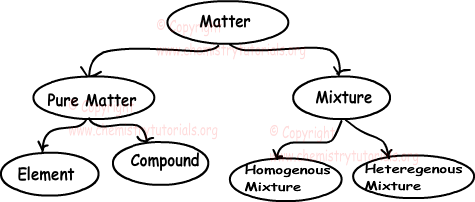
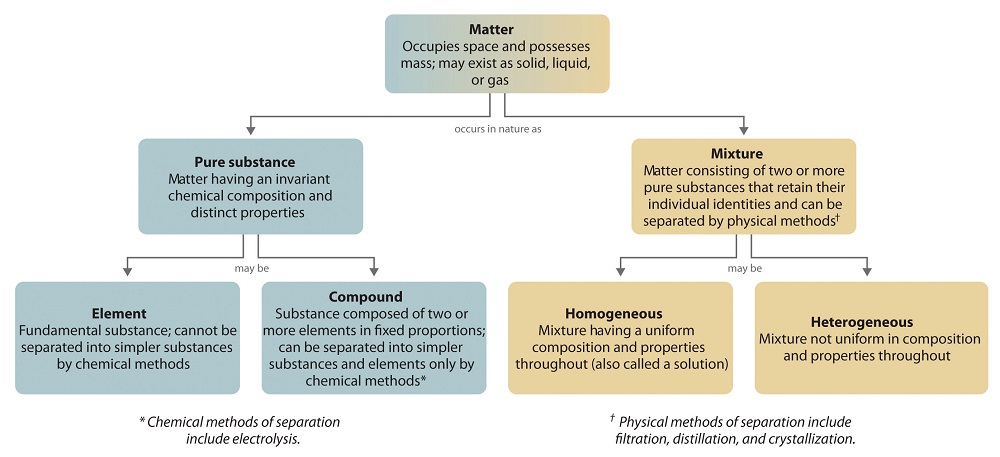
Matter is a term used for everything having mass and volume. In this unit we will deal with types of matters. Pure substance, elements, compounds, mixtures are subjects of this unit.

classification of matter


1) Pure Matter: Same types of atoms or molecules comprise pure matters. They have some distinguishing properties. There are two pure matters, elements and compounds. Iron, alcohol, salt are examples of pure matters.
Properties of Pure Matters:
  • They are homogeneous.
  • They have specific physical properties like boiling point, density or freezing point.
  • Temperature during phase change is constant
Now we explain pure substances one by one.
a) Elements: Element is the simplest matter which contains one type of atom. There are 109 known element in nature. We show elements with symbols like for iron we use "Fe".
Carbon "C"
Beryllium "Be"
b) Compounds: Two or more than two elements come together in specific amounts and form new matter that we call compound. Properties of compounds are totally different from elements comprising it. We show compounds with formulas like water H2O. Ions or molecules can produce compounds.
Salt "NaCl"
Ammonia "NH3"
Iron III Oxide "Fe2O3"
Properties of Compounds:
  • All compounds are pure substances
  • Smallest particle of compound is molecule including different types of atoms
2) Mixture: Different two or more than two types of matter (element, molecule, compound) are mixed to get mixture. All matters forming mixture keep their original properties. They are not pure matters. We can explain mixtures under two titles, homogeneous mixtures and heterogeneous mixtures.
a) Homogeneous Mixtures: All parts of mixture show same properties in homogeneous mixtures. We can call homogeneous mixtures as solutions. Salt water, sugar water, air are examples of homogeneous mixtures.
b) Heterogeneous Mixtures: Mixtures do not show same uniformity in all parts of it. In this types of mixtures, you can see different phases of matters. Water+Sand, milk, blood, soil are some common examples of heterogeneous mixtures.
Emulsion: Heterogeneous mixture including two different liquids. For example, oil-water, gasoline-water are emulsion examples.
Suspension: Heterogeneous mixture produced by one solid and one liquid matter.Sand-water, naphthalene-water are examples of suspension.
Colloids: are heterogeneous mixture type. Solute matters are homogeneously distributed in  solvent however; we can see particles of solute with naked eye or microscope in colloids but, in solutions we can not see particles with microscope. Thus; colloids are assumed to be heterogeneous mixture.
Example: Which one of the following is heterogeneous mixture?
I. Coke
II. Sea Water
III. Water+Sand
IV. Natural Gas
Coke, sea water and natural gas are homogeneous mixture but water sand is heterogeneous mixture.
Differences between Compounds and Mixtures
  1. Ratio between matters forming compound is constant but ratio between matters forming mixture is variable.
  2. Matters forming compounds loose their properties but matters forming mixtures preserve their properties.
  3. We can decompose compounds with chemical methods but decompose mixtures with physical methods.

Tuesday, May 29, 2018

EXERCISES CLASSIFICATION OF MATTER

Q1.
Material
Pure Substance
or Mixture
Element, Compound,
Homogeneous, Heterogeneous
sugar + pure water
(C12H22O11 + H2O)


Iron (Fe)


limestone (CaCO3)


orange juice


Pacific Ocean


air inside a balloon


aluminum (Al)


magnesium (Mg)


acetylene (C2H2)


tap water in a glass


pure water (H2O)


chromium (Cr)


salt + pure water
(NaCl + H2O)


benzene (C6H6)


baking soda (NaHCO3)


Q2.
Classify each of the following as elements (E), compounds (C) or Mixtures (M).  Write the letter X if it is none of these.

1. Diamond(C)                     
2. Sugar (C6H12O6)             
3. Milk            
4. Iron (Fe)
5. Air                          
6. Sulfuric Acid (H2SO4)    
7. Gasoline               
8. Electricity
9. Krypton (K)           
10. Bismuth (Bi)                  
11. Uranium (U)      
12. Popcorn
13. Water (H2O)       
14. Alcohol (CH3OH)          
15. Pail of Garbage 
16. A cat
17. Ammonia (NH3)
18. Salt (NaCl)                     
19. Energy                
20. Gold (Au)
21. Wood                  
22. Ink                                   
23. Pizza
24. Dry Ice (CO2)     
25. Baking Soda (NaHCO3)          
26. Titanium (Ti)      
27. Concrete

Q3.
Read the following information on elements, compounds and mixtures.  Fill in the blanks where necessary.

Elements (pure substances):
1.      A pure substance containing only one kind of _______1_____.
2.      An element is always uniform all the way through (homogeneous).
3.      An element _______2______ be separated into simpler materials (except during nuclear reactions).
4.      Over 100 existing elements are listed and classified on the _________3_______.

Compounds (pure substances):
5.      A pure substance containing two or more kinds of ______4_________.
6.      The atoms are _________5________ combined in some way.  Often times (but not always) they come together to form groups of atoms called molecules. 
7.      A compound is always homogeneous (uniform).
8.      Compounds __________6_________ be separated by physical means.  Separating a compound requires a chemical reaction. 
9.      The properties of a compound are usually different than the properties of the elements it contains. 

Mixtures:
10.  Two or more ________7________ or ________8________ NOT chemically combined.
11.  No reaction between substances.
12.  Mixtures can be uniform (called ____________9____________) and are known as solutions.
13.  Mixtures can also be non-uniform (called __________10______________).
14.  Mixtures can be separated into their components by chemical or physical means.